Instruments

A violin by Charles Bailly
A violin by Charles Bailly

1913 | France

A great condition more than 100 years old French violin. This violin was made by Charles Bailly – well known and recognized French luthier.

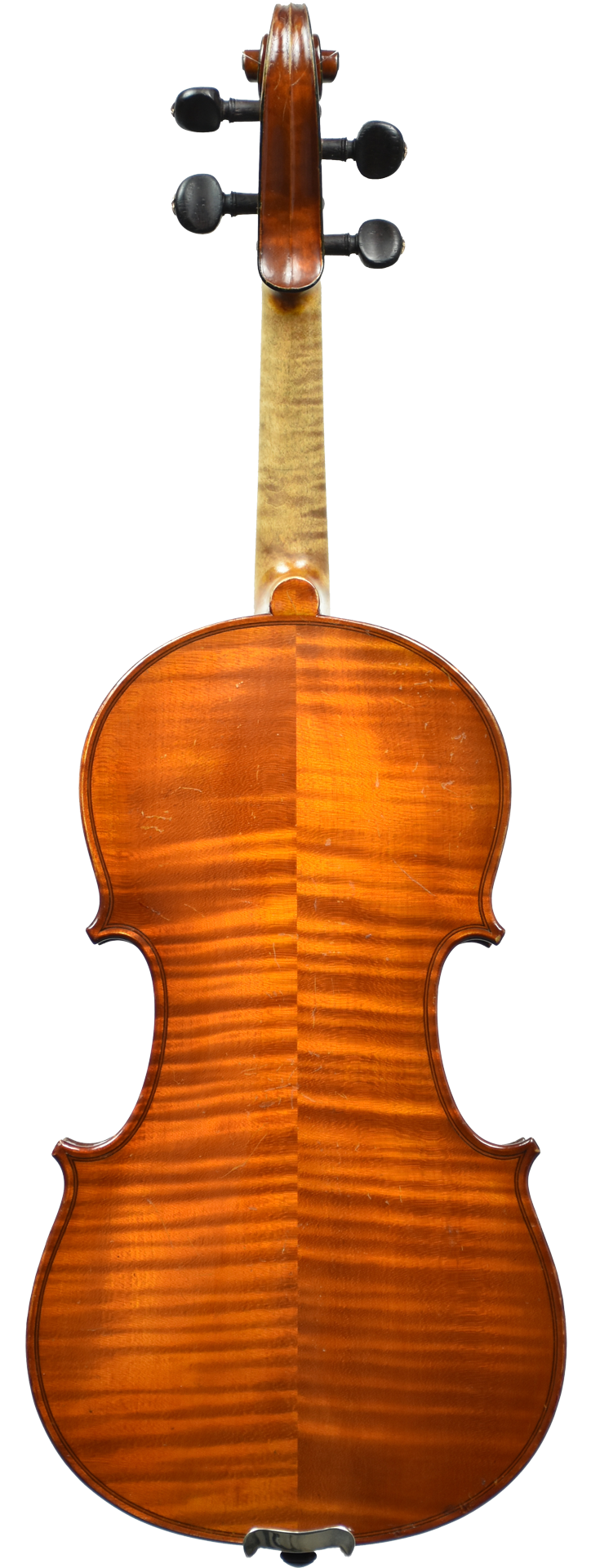
Charles Bailly (1879 – 1957), son of Joseph Bailly. He was a student of Georges Lotte and Paul Mangenot. worked in Mirecourt from the early 20th century. He also produced instruments for the Mougenot and Marc Laberte and Claude Francois Humbert firms. He established his own shop in 1909 and worked independently on rue General Mangin, where he remained active until 1926. His creations featured classical models with a transparent golden-brown varnish and were signed with his labels, also used iron mark on the lower rib (please see our picture). His work is characterized by a high degree of precision, a bold French aesthetic, and the use of excellent tonewoods. The violin we offer, dated 1913 (instrument No. 478), represents Bailly in his prime (best), showcasing the clean, “grand” style that defined the late 19th and early 20th-century French workshop tradition.

Charles Bailly was a father of Rene Bailly, whose outstanding violin we offered before.

This violin is based on Stradivari broad model (Large Pattern), often favored by French makers like J.B. Vuillaume and his successors.

The arching is typically French for this period—relatively flat and broad. It rises quickly from the purfling channel and carries its height well toward the edges. This “flat” arching is designed for projection and a brilliant, “soloistic” tonal palette.

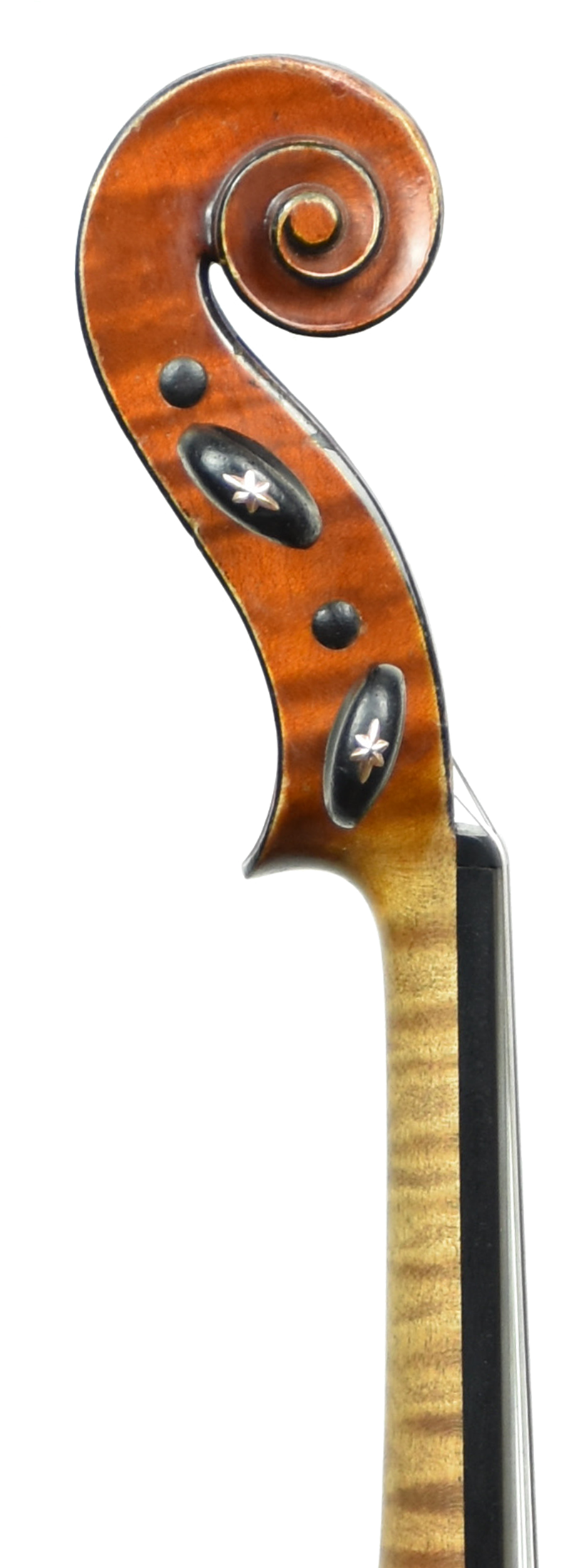
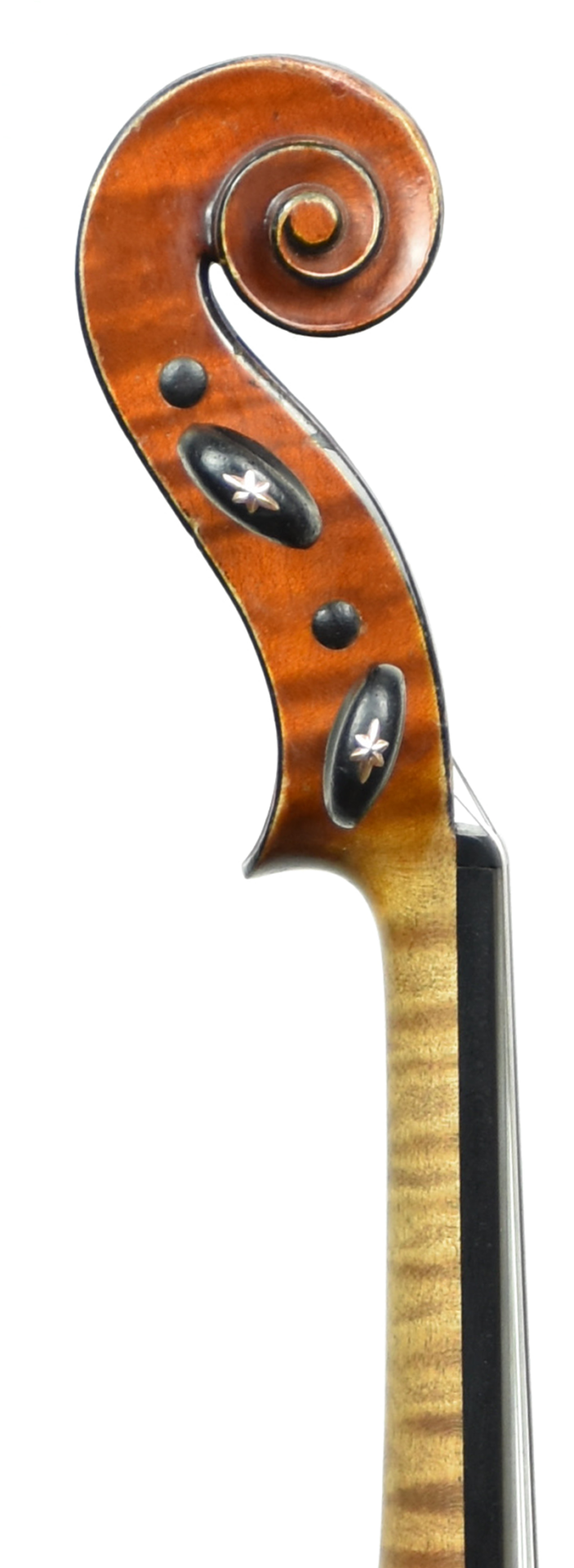
The scroll: It is deeply and cleanly carved with a prominent center eye. The turns are symmetrical and reflect a high level of tool control.

The Chamfer: The edges of the scroll (the chamfers) are highlighted with black ink or “picked out,” a classic French stylistic trait that accentuates the silhouette.

The Pegbox is made of beautifully flamed maple that matches the neck and back.

Corners: The corners are elegant and medium-long, pointing slightly outward in the Stradivarian fashion.

Purfling: The purfling is expertly inlaid. The mitres (the “bee-stings”) in the corners point precisely into the center of the corner wood.

Excellent choice of tone wood. The back is made of two-piece maple with a strong, medium-to-wide flame descending slightly from the joint. The “tiger-stripe” figure is deep and highly refractive (chatoyant).

The Ribs and Neck: Perfectly matched to the back, showing a consistent flame.

Straight-grained spruce with a fine grain in the center, widening slightly toward the flanks—ideal for acoustic vibration.

The varnish is a rich, transparent orange-red over a golden grounding, beautifully exposing attractive texture of the wood.

The Pegs are original and exceptionally beautuiful. Made of boxwood, they have a decorative Parisian-style gold star inlays.

Chinrest, fingerboard, tailpiece made of ebony. Kevlar tailgut.

Inside there is a label:

“INSTRUMENTS D’ARTISTES, Charles Bailly, Année 1913, No 478″

There is an ironmark “CHARLES BAILLY” at the lower rib.

This violin has been restored by a  chairman of Polish Violin Makers Association Mr. Pielaszek. He is father or recent international star of violin making – Piotr Pielaszek, who has won many awards and whose violins reach 30+ thousand EUR. He put his properly adjusted bridge on this violin – signed Marek Pielaszek.

The violin is equipped with new high quality strings: Larsen Il Cannone Medium. These strings are one of the top choice of professional violinists (e.g. our violinist who is a concertmaster at the orchestra uses these strings). The strings have multifilament-fibre nylon core with pure silver winding (D and G) and aluminum winding (A).  These strings help produce strong yet colourful sound, enriching with overtones and enhancing selectivity of the violin and bow.  These strings are used by e.g. Renaud Capuçon and Rusanda Panfili.

Size:

Body length – 357mm

Upper body – 168mm

Lower body – 208mm

Excellent soloist sound. Rich in overtones. Great projection. Violin for professionals. Very satisfying, deep in lower registers and melodic in higher registers. Crisp precise sound. Very selective and responding. Especially beautiful higher registers on A and E string. This violin offers a whole scope of sounds – from delicate sweet to bright open with great projection. As it has a very good projection, it sounds well on the stage and in concert hall. It’s very versatile and broad scope of colors and tones.